Stinging insect nest extraction protects residential envelopes in Franklin County from territorial colonies that nest along rooflines, dormers, and architectural trim. When social wasps establish nests beneath vinyl…
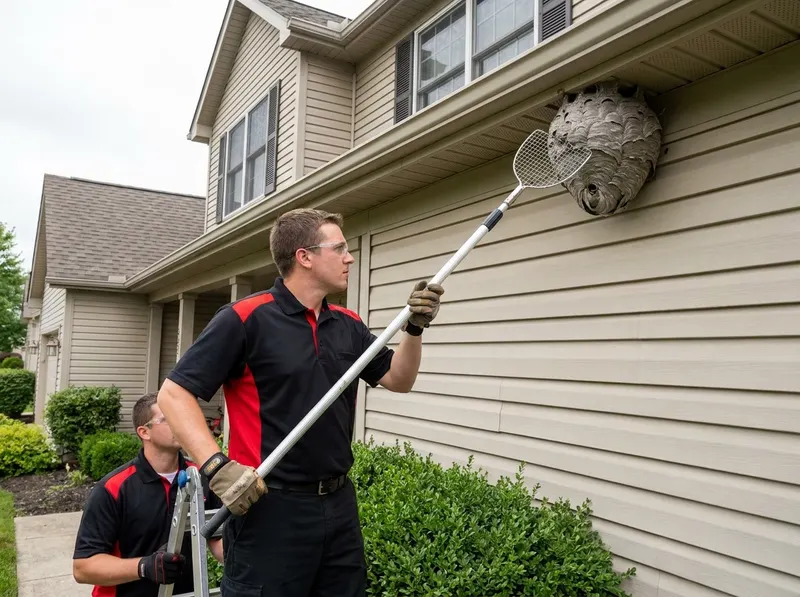
Stinging insect nest extraction protects residential envelopes in Franklin County from territorial colonies that nest along rooflines, dormers, and architectural trim. When social wasps establish nests beneath vinyl fascia or within wall voids, aerial foraging paths intersect with patios, swing sets, and entrance doors. Homeowners near Jefferson Run and Woods at Jefferson frequently observe paper wasps (Polistes dominula) colonizing sheltered southern eaves, where afternoon radiant heat accelerates brood rearing. Unmanaged colonies expand from a few workers in May to over 200 individuals by August. Aerial yellow jackets and bald-faced hornets (Dolichovespula maculata) create enclosed, spherical paper carton nests that hang from upper tree limbs, porch ceilings, or gutter corners along Havens Corners and Pinecrest properties. Standard over-the-counter jet sprays often fail to penetrate these multi-layered cellulose envelopes, agitating the guard insects and increasing sting frequency for nearby children and pets.
Extracting nests requires species-specific isolation rather than arbitrary broadcast spraying. ZephyrCrest Insect Protection implements perimeter-first protocols guided by standards from the US EPA Integrated Pest Management program. Technicians evaluate colony access points, directional flight paths, and architectural vulnerabilities. Ground-nesting yellow jackets (Vespula vulgaris) burrowing into landscaped beds or turf along Blacklick Ridge and Broadview Heights require specialized subterranean injection to target deep brood combs, followed by mechanical soil extraction. For elevated structures around Sable Ridge and Farms at Jefferson, telescoping extraction rigs apply targeted, non-repellent aerosol contacts that freeze workers on contact before our team cuts the attachment stalk, safely detaching the entire nest into containment bags. Residual botanical or synthetic pyrethroid barriers are then applied directly to the anchoring substrate to disrupt pheromone trails, preventing secondary queens from establishing replacement combs in the same eave hollow.
Safety protocol dictates clear operational distinctions based on the nesting site. In-wall nesting events where yellow jackets enter via brick weep holes or siding transitions require precise non-invasive dust void injection rather than sudden hole sealing. Sealing an active wall void entrance forces thousands of defensive wasps into interior living areas through baseboards and electrical outlets, violating structural management recommendations outlined by the OSHA personal protective equipment standards and residential housing codes. The following sequential protocol ensures thorough colony eradication and domestic security:
Ecological responsibility remains paramount when addressing beneficial native pollinators. Honeybees (Pollinator Partnership) and native bumblebees (Xerces Society for Invertebrate Conservation) receive non-lethal management whenever feasible. When feral honeybee swarms select structural walls or soffits near Blacklick Woods Metro Park or Jefferson Country Club, ZephyrCrest Insect Protection coordinates with local apiarists affiliated with the Ohio Department of Agriculture Apiary Program for careful trap-out and hive relocation, reserving lethal extraction exclusively for aggressive, non-pollinating wasps that pose imminent sting hazards. All chemical applications adhere strictly to National Pesticide Information Center toxicity indices, ensuring surfaces dry quickly and leave zero airborne drift inside domestic environments. For scheduling, call (380) 255-6032.
Every job gets a firm, written price after an on-site visit.
Tell us about your stinging insect nest extraction job in Blacklick and we'll send a clear, written quote, usually the same day.
 ZephyrCrest Insect Protection