Residential properties across Blacklick experience substantial seasonal arachnid movement driven by moisture and dense natural vegetation. Developments near the waterways of the Blacklick Woods Metro Park and open…
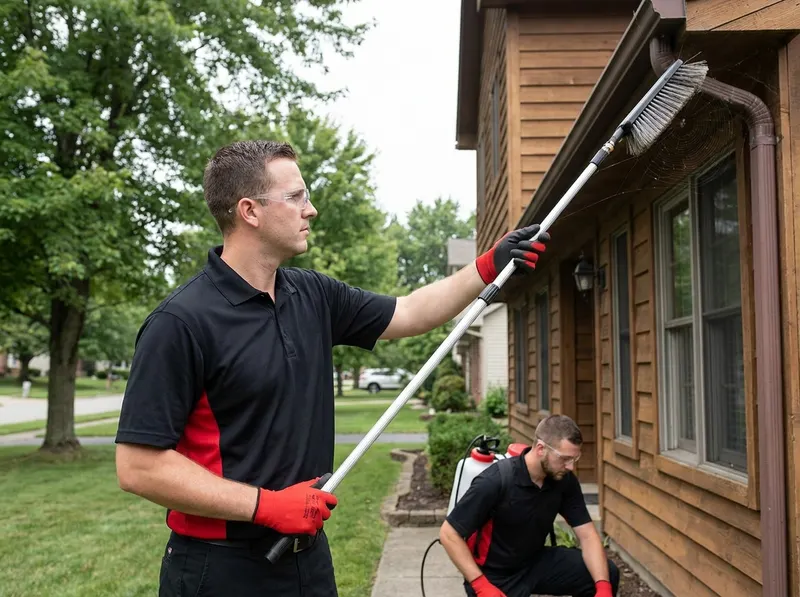
Residential properties across Blacklick experience substantial seasonal arachnid movement driven by moisture and dense natural vegetation. Developments near the waterways of the Blacklick Woods Metro Park and open green spaces bordering the Jefferson Country Club host elevated insect populations that serve as an abundant food reservoir for predatory arachnids. Structural eaves, vinyl soffits, window assemblies, and brick weep screeds provide shelter for common species like wolf spiders (Lycosidae) and yellow sac spiders (Cheiracanthium inclusum). Left unmanaged, spiders establish structural webbing across exterior light fixtures, composite decks, and covered porches, ultimately trailing wandering insect prey indoors through microscopic expansion gaps in exterior cladding.
Effective arachnid suppression balances physical removal with chemical deterrence based on standard structural pest management practices outlined by the National Pest Management Association. Unlike flying insects that groom their legs and readily ingest surface residues, wandering spiders possess minimal contact surface area and high tarsal stance, making broadcast surface sprays inefficient. Our application deploys microencapsulated synthetic pyrethroids designed to adhere to coarse vertical siding, mortar joints, and downspout attachments. Guidance from the U.S. Environmental Protection Agency prioritizes targeted perimeter applications to intercept pests outside building envelopes without oversaturating residential turf.
Property layout determines the operational protocol. Homes in Woods at Jefferson, Jefferson Run, and Pinecrest featuring mature tree canopies face elevated aerial orb weaver populations on second-story overhangs, requiring specialized telescoping carbon-fiber poles to sweep egg sacs clean. Conversely, newer single-family constructions across Sable Ridge, Blacklick Ridge, and the Farms at Jefferson exhibit higher ground-level migrations of wolf spiders through unfinished basement rim joists and walk-out sliding thresholds. Adherence to safety protocols regulated by the Ohio Department of Agriculture ensures liquid applications cure within 60 minutes, remaining stable against precipitation while remaining inaccessible to household pets once dry.
Long-term suppression relies on sequential execution rather than indiscriminate chemical dispersal:
Homeowners in Broadview Heights and Havens Corners often weigh professional perimeter exclusion against self-applied aerosol sprays. Over-the-counter pyrethrin aerosols break down within 48 to 72 hours under direct sunlight exposure, requiring weekly respraying that leaves unsightly oily residue on vinyl siding. Professional suppression implements durable micro-suspension chemistry that remains active for 60 to 90 days. This scientific approach follows ecological conservation principles advocated by the Xerces Society for Invertebrate Conservation, focusing exclusively on domestic structural perimeters to preserve beneficial non-target organisms across suburban yard boundaries.
Every job gets a firm, written price after an on-site visit.
Tell us about your spider suppression & web clearing job in Blacklick and we'll send a clear, written quote, usually the same day.
 ZephyrCrest Insect Protection