ZephyrCrest Insect ProtectionZephyrCrest Insect Protection

Exterior Mosquito Reduction Barriers Blacklick

Residential properties in eastern Franklin County face high seasonal insect pressure due to natural humidity gradients along riparian zones like Blacklick Woods Metro Park and the Blacklick Creek Greenway Trail.…
Get My Estimate →(380) 255-6032
Exterior Mosquito Reduction Barriers in Blacklick, OH
Quick answer
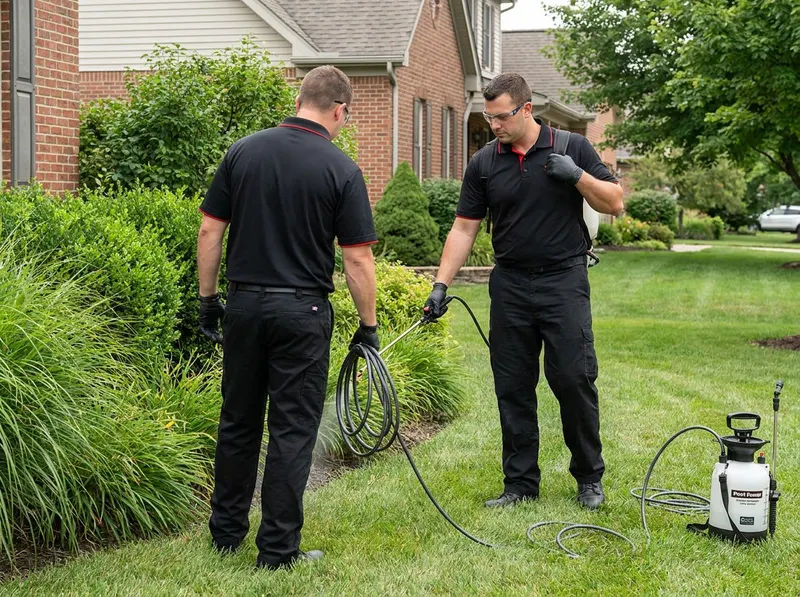
  • Application involves targeted misting of underside shrub leaves, deck undersides, and property perimeters up to a 10-foot vertical ceiling.
  • Initial knockdown of adult populations begins within 2 hours, with residual barrier longevity lasting 21 to 30 days.
  • Services start at a $150 minimum fee covering up to a one-third-acre residential lot.
  • Field treatments eliminate standing breeding sources by applying biological larvicide dunks containing Bacillus thuringiensis israelensis to non-potable water collections.
  • Service is scheduled directly by phoning (380) 255-6032, followed by an on-site property evaluation prior to treatment.

Residential properties in eastern Franklin County face high seasonal insect pressure due to natural humidity gradients along riparian zones like Blacklick Woods Metro Park and the Blacklick Creek Greenway Trail. Properties in Woods at Jefferson and Jefferson Run frequently experience high densities of Aedes albopictus (Asian tiger mosquito) and Culex pipiens, which harbor in dense ornamental shrubbery and shaded turf margins during peak daytime heat. Standard broadcast spraying often fails because adult mosquitoes rest beneath broad foliage rather than on upper leaf surfaces. A scientific perimeter barrier applies residual droplets directly to these microclimates using specialized air-assisted mist blowers. The formulation adheres to the foliage underside, providing continuous control as insects land, while remaining stable through typical central Ohio rainfall patterns documented by the National Weather Service Wilmington Office.

Selecting a targeted perimeter barrier over automatic whole-yard misting systems reduces chemical volume while protecting beneficial pollinators. Permanent misting arrays emit indiscriminate sprays that drift across non-target flowers, conflicting with regional conservation standards outlined by the Pollinator Partnership. In contrast, an exterior barrier treatment strictly isolates vegetative resting zones, foundation perimeters, and drainage swales while completely avoiding blooming plants and vegetable beds. For homeowners along Havens Corners and Broadview Heights, this method establishes an invisible defensive ring around outdoor living areas. Properties bordering wet lowlands in Pinecrest or Sable Ridge balance high outdoor activity with effective suppression by establishing 21-day service cadences between May and October, adhering to integrated pest management principles established by the US Environmental Protection Agency.

Implementation follows a structured, transparent process to eliminate active adults and halt reproductive cycles without complex contracts:

  1. Step 1 involves an inspection of the property perimeter, locating shaded harborage sites and unmanaged drainage reservoirs around downspouts or decorative landscape elements.
  2. Step 2 introduces targeted biological control agents, deploying micro-dose formulations certified under Centers for Disease Control and Prevention larvicide guidelines directly into standing yard water that cannot be drained.
  3. Step 3 applies a microencapsulated polymer barrier across fence lines, shaded ornamental groupings, and patio overhangs using low-drift calibration techniques verified by the Michigan State University IPM Program.
  4. Step 4 completes a post-application inspection to verify that treated surfaces have dried completely, ensuring safety for domestic pets and family members according to standard chemical label requirements from the Ohio Department of Agriculture.

Dense, older-growth parcels in Blacklick Ridge and the Farms at Jefferson require precise chemical placement rather than sheer application volume. Canopy height, localized wind corridors near the Jefferson Country Club golf course, and proximity to non-target aquatic environments dictate whether a motorized backpack mist unit or a coarse-droplet ground wand is employed. Formulations integrate microencapsulated synthetic pyrethroids with juvenile hormone mimics recognized by the World Health Organization Pesticide Evaluation Scheme. This dual action targets adult nervous systems upon physical contact while preventing surviving juvenile larvae from molting into viable adults. Operational guidance aligns with urban vector control recommendations from the Entomological Society of America and environmental run-off management standards from the U.S. Fish and Wildlife Service, ensuring that localized residential treatments maintain absolute ecological balance. To schedule service, call (380) 255-6032.

How much does Exterior Mosquito Reduction Barriers cost in Blacklick?

Standard Suburban Lot (Up to 0.33 Acre)$150 - $185 per application
Half-Acre Property with Heavy Perimeter Brush$185 - $235 per application
Full-Acre Estate Lot (Expanded Woodline Barrier)$260 - $340 per application
Seasonal 5-Treatment Program (Single Home)$750 - $925 total program
One-Time Outdoor Event Application (Grounds & Perimeter)$175 - $250 per event

Every job gets a firm, written price after an on-site visit.

Common questions

What is the baseline cost for exterior mosquito reduction barriers in Blacklick?
Pricing starts at a minimum fee of $150 for standard suburban properties up to one-third of an acre in Blacklick, with exact rates verified on-site based on linear vegetative footage.
How soon after a Blacklick barrier treatment can children and pets use the lawn?
Treated outdoor areas in Blacklick can be fully re-entered as soon as the liquid application has dried completely, which takes approximately 30 to 45 minutes in typical summer humidity.
Do exterior mosquito reduction barriers withstand heavy rainfall in Blacklick?
Yes, formulations utilize microencapsulated polymers that bind to organic leaf surfaces within 60 minutes of application, remaining resilient through typical Franklin County summer storms.
Are blooming flower beds and vegetable gardens sprayed during a Blacklick application?
No, treatments in Blacklick strictly exclude open blossoms, pollinator gardens, and edible vegetation to safeguard honeybees and native beneficial species from chemical contact.
How frequently should properties along Blacklick Creek receive barrier treatments?
Properties near waterways such as Blacklick Creek benefit most from barrier renewals applied every 21 to 28 days from May through late September to suppress sequential breeding cycles.

Get started today

Tell us about your exterior mosquito reduction barriers job in Blacklick and we'll send a clear, written quote, usually the same day.

Get your PEST CONTROL SEVICE quote, Blacklick

We only use your ZIP to check availability, no spam.